
GUIDE: AI That Designs and Grades Instruction
Learning science, made executable
Project Background:
AI can generate a lesson plan in seconds. But is it any good? As generative AI floods instructional design with fast content, the bottleneck has shifted from creating instruction to evaluating it. Human expert review doesn't scale, and most automated evaluation checks style rather than substance. I built GUIDE, the Grounded Universal Instructional Design Evaluator, to close that gap.
GUIDE is an open-source, LLM-as-a-judge framework that translates peer-reviewed learning science into automated evaluation rubrics. It organizes evaluation into 10 archetypes mapped to the ADDIE lifecycle: needs analysis, instructional sequencing, story design, cognitive neuroscience, multimedia design, accessibility, adult learning communication, assessment design, formative evaluation, and curriculum alignment. Across those archetypes are 60 dimensions, each scored 1 to 5 against concrete behavioral anchors. Every scoring criterion is grounded in named research: Knowles on adult learning, Mayer on multimedia, Sweller on cognitive load, Gagné on instructional events, Bloom on assessment, and more. Nothing is scored on vibes.
GUIDE works in both directions. In evaluate mode, feed it an e-learning storyboard and the multimedia archetype scores it on six dimensions. A module that narrates text word-for-word on screen takes a 2 on Extraneous Load Reduction (that's Mayer's redundancy principle), while clean segmenting into short learner-paced sections earns a 5 on Intrinsic Load Management. Six dimension scores roll up to an overall verdict: ship, light revision, revise, or redesign. The output isn't just a grade, it's cited rationale a designer can act on.
In design mode, the same rubrics become forward-looking criteria, so content is authored against the dimensions instead of graded after the fact. The samples featured below came out of this mode: a complete 90-minute hands-on workshop, including a facilitator guide whose run-of-show is tagged segment by segment to Gagné's nine events and Keller's ARCS motivation moves, a matching slide deck, a one-page job aid, and a design self-check appendix. It even applies the needs-analysis archetype's discipline up front, flagging environmental blockers like access and permissions as "not a training problem." Design mode finishes with a self-evaluation pass, so the artifact ships already knowing its own score.
GUIDE is also packaged as a Claude skill and installable plugin, so the framework works where designers actually work. The skill self-activates on instructional design tasks and routes to the right archetypes in either mode. The plugin goes further, bundling a 13-agent ADDIE pipeline: a router that classifies the request, ten archetype specialists that design or judge each phase, an alignment gate, a synthesizer that rolls every scorecard into one verdict, and a reviser that loops targeted fixes until the composite clears threshold.
I built GUIDE as a self-imposed capstone synthesis of my M.A. in Instructional Design & Technology at UCF, and released it under the Apache 2.0 license so any team can use or extend it. It reflects everything I believe about this field: good instruction is defensible, not merely tasteful. Now that standard can scale, in both directions: generating content that meets it and grading content against it.
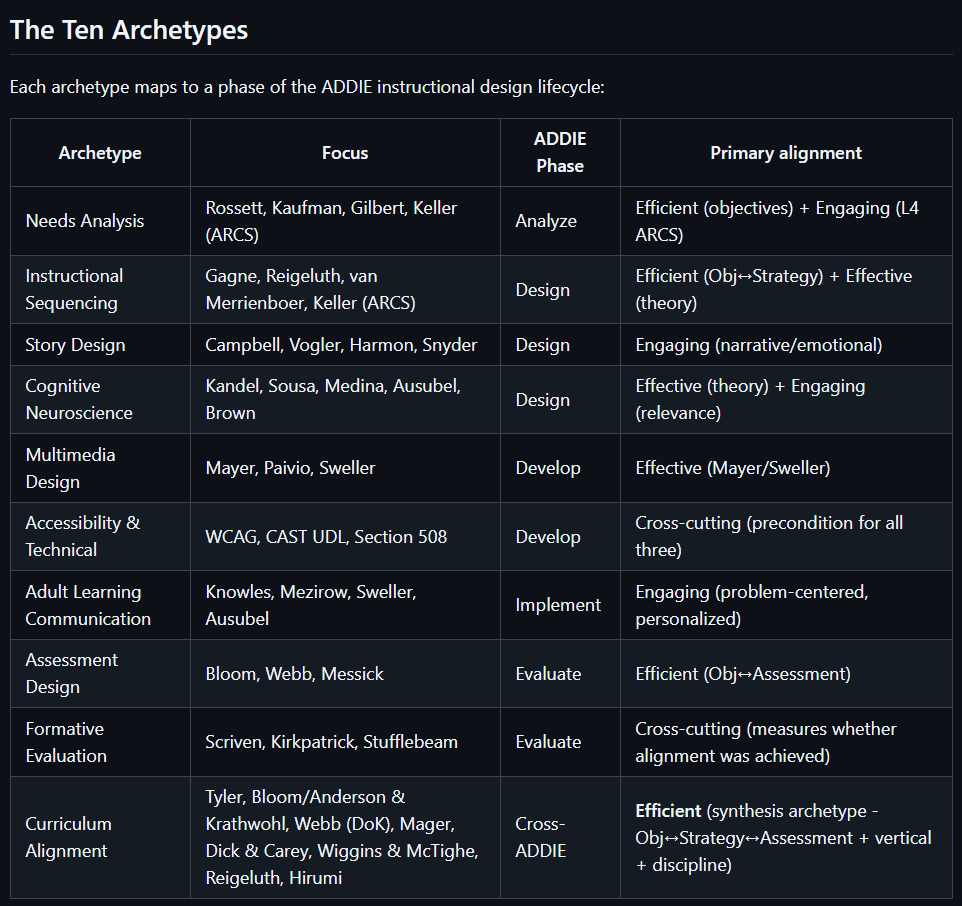
Select this image to view the 10 archetypes and how they map to the ADDIE lifecycle.
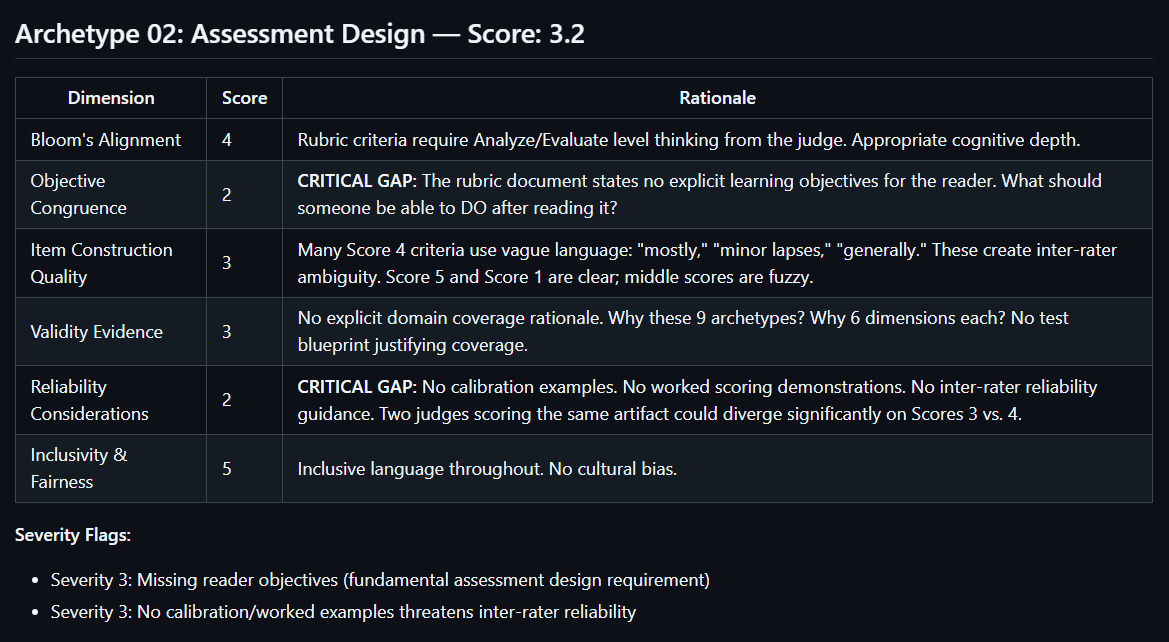
Select this image to see a sample scorecard: six dimension scores, rationale, severity flags, and a verdict.
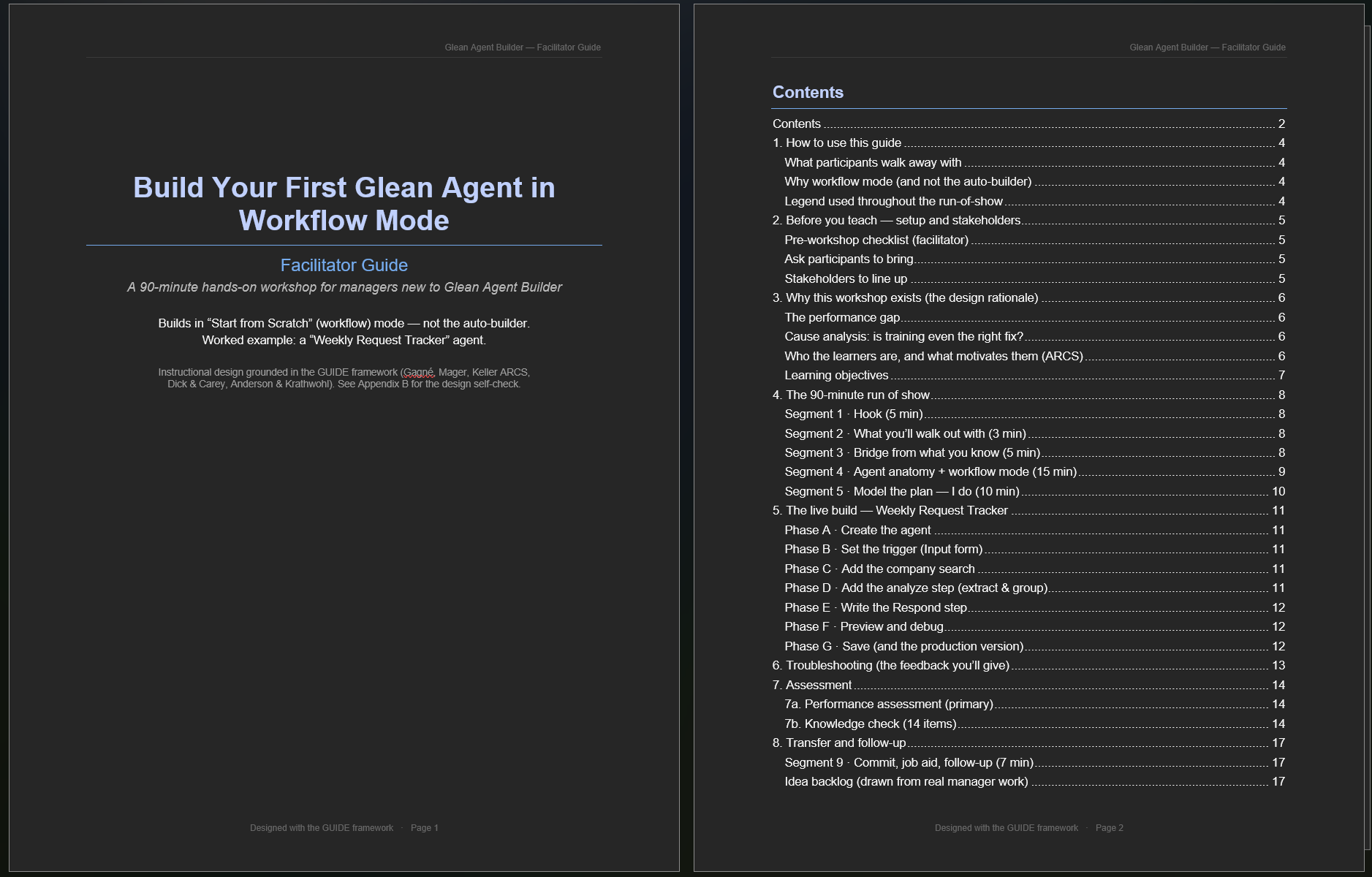
Select this image to view a facilitator guide generated in design mode, with every segment tagged to Gagné's events and ARCS motivation moves.
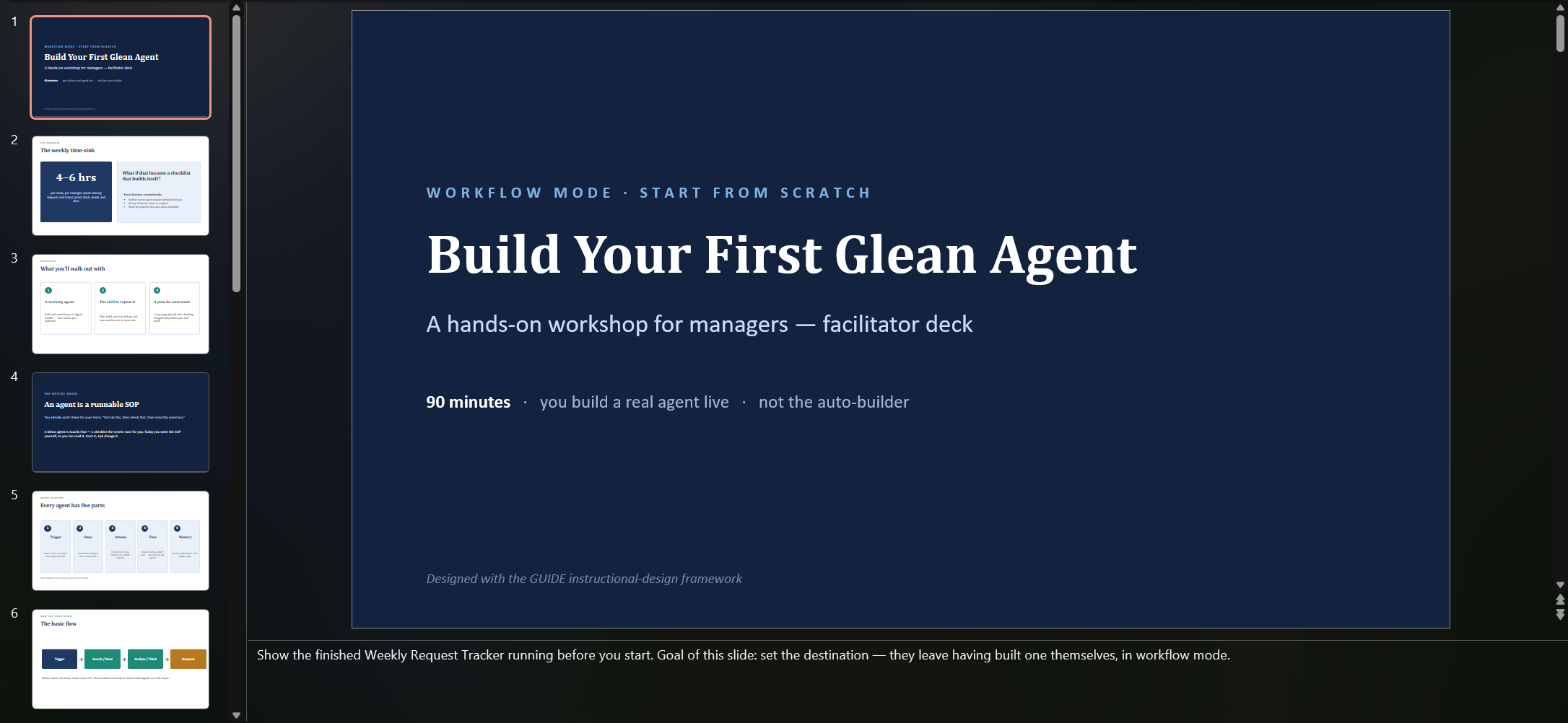
Select this image to see the matching slide deck, generated as part of the same workshop package.
What was my role in this project?
Conducted the literature synthesis across learning-science research to define 10 evaluation archetypes and 60 scoring dimensions
Wrote behavioral scoring anchors for every dimension so evaluations are consistent and defensible rather than impressionistic
Designed the LLM-as-a-judge architecture, including judge prompts, structured JSON outputs, severity flags, and revision-decision thresholds
Built and tested the framework in Python and validated scoring against artifacts with known strengths and weaknesses
Packaged GUIDE as a Claude skill and installable plugin, including a 13-agent ADDIE pipeline that designs, evaluates, and revises content end to end
Used design mode to generate complete instructional packages, including facilitator guides, slide decks, and job aids that ship with their own self-check
Wrote the documentation and model-agnostic handoff files so the framework works across LLM platforms
Released and maintain the project as open source under Apache 2.0, with versioned marketplace distribution for the plugin
This project was made with the following tools:

Claude

Python